





















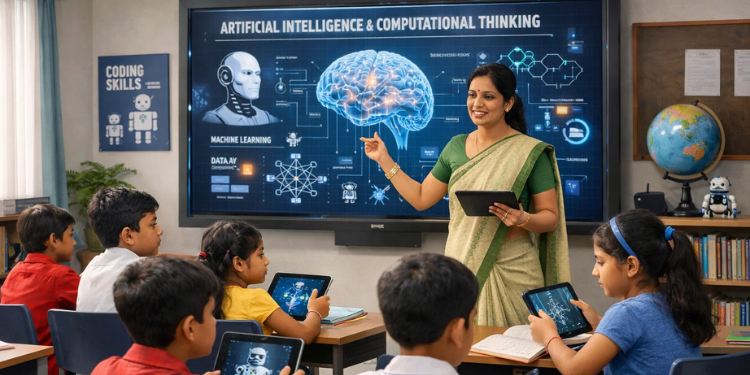
On April 1, 2026, Union Education Minister Dharmendra Pradhan officially launched a new curriculum on Computational Thinking (CT) and Artificial Intelligence (AI) for students of Classes 3 to 8 under the Central Board of Secondary Education (CBSE).
The initiative, set to be implemented from the 2026–27 academic session, aims to equip students with essential future-ready skills such as:
- Logical reasoning
- Problem-solving
- Pattern recognition
It also introduces students to the role of Artificial Intelligence in everyday life, marking a significant step towards modernizing school education in India.
🚀 A Transformative Step Towards Future Learning
The government has described this move as a major transformation in education, aligning with global trends where AI and computational thinking are becoming core skills.
The curriculum has been carefully designed by experts from leading institutions and focuses on:
- Activity-based learning
- Integration with subjects like Math, Science, and Languages
- Ethical understanding of AI
Unlike traditional subjects, Computational Thinking will not be taught separately, but will be embedded within existing subjects through puzzles, activities, and real-life problem-solving exercises.
⚠️ The Big Concern: Are Students Ready?
While the curriculum is ambitious and forward-looking, experts have raised a critical concern — students’ foundational literacy skills.
At the core of all learning lies the LSRW framework:
- Listening
- Speaking
- Reading
- Writing
These are essential for understanding and applying computational thinking concepts. However, current data suggests that many students are still struggling with basic reading skills.
📊 What the Data Reveals
According to the Annual Status of Education Report 2024 (ASER), a large number of students face difficulties in reading:
- More than 50% of Class 5 students cannot read a Class 2-level text
- This issue is not limited to rural schools but is also visible in urban and private institutions
Similarly, findings from the PARAKH Rashtriya Sarvekshan 2024 show that:
- Learning gaps exist across school types
- In some cases, private school students performed lower than expected
This raises a serious question:
👉 Can students effectively learn AI and computational thinking without strong reading and comprehension skills?
🎯 The NIPUN Bharat Connection
The government had earlier launched the NIPUN Bharat Mission to ensure that every child achieves foundational literacy and numeracy by Grade 3 by the year 2026–27.
However, recent data indicates that:
- Progress has been made
- But the mission is not yet fully achieved
This creates a gap between policy goals and ground reality, especially as the new AI curriculum is being introduced in the same timeline.
📚 Why Literacy Matters for AI Learning
The new CT curriculum relies heavily on:
- Reading instructions
- Interpreting questions
- Writing responses
- Participating in discussions and projects
From Class 6 onwards, students will be required to:
- Create project presentations
- Maintain reflective journals
- Complete written assignments
Without strong literacy skills, students may struggle—not with AI—but with understanding the questions themselves.
🌍 Global Perspective
Countries like:
- Finland
- Singapore
- South Korea
have successfully introduced AI in schools—but only after achieving high levels of foundational literacy.
In contrast, India is attempting to introduce advanced skills while still addressing basic learning gaps.
🧠 The Way Forward
The introduction of AI and Computational Thinking is undoubtedly a progressive and necessary step. However, experts suggest that:
- Foundational literacy must be strengthened alongside
- Implementation should be carefully phased
- Learning gaps must be addressed early
Because ultimately,
👉 A curriculum is only as strong as the student who experiences it.
Source: The Hindu
For more such important school and education updates, follow School Samachar and stay informed with every latest development in the education world.