













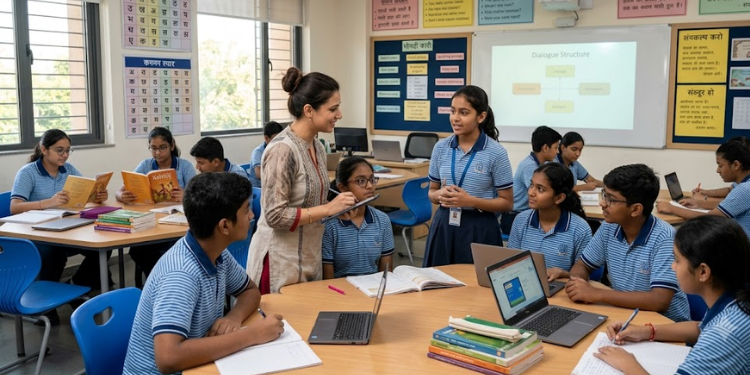
The Central Board of Secondary Education (CBSE) has issued a new circular introducing the R3 Language Assessment Framework for Class IX for the 2026–27 academic session. Along with the framework, NCERT has made the R3 Language Learning Resources available on its official website, enabling schools to begin implementation in line with the National Education Policy (NEP) 2020.
The R3 curriculum follows an Oral-First Pedagogy, where students first develop listening and speaking skills before progressing to reading and writing. The framework aims to make language learning more interactive, practical, and competency-based.
Assessment Structure (Total: 100 Marks)
The entire assessment will be school-based and divided into four major components:
- Listening & Speaking Skills – 40 Marks
- Creative Writing – 15 Marks
- Language Assessment Based on Learning Resources – 30 Marks
- Reading Skills – 20 Marks
- Writing Skills – 10 Marks
- Project Work – 15 Marks
Listening & Speaking Skills
Schools are required to conduct continuous classroom-based activities throughout the academic session. Students will be assessed through any eight activities, each carrying 5 marks, from suggested tasks such as:
- Listening and responding to instructions
- Picture or object description
- Pair and group conversations
- Self-introduction
- Story narration
- Role plays
- Debates
- Listening to announcements or interviews
- Story retelling
Teachers may also introduce additional contextual activities that encourage active language learning.
Creative Writing Component
The 15-mark writing section includes:
- Informal invitation or message writing
- Picture description
- Story writing (up to 100 words)
- Everyday life dialogue writing
The evaluation will focus on content, originality, organization of ideas, creativity, coherence, and language usage.
Reading & Writing Assessment
The language assessment will be based entirely on the NCERT R3 Learning Resources taught in classrooms.
Students will attempt:
- Reading comprehension from two seen passages
- Short answer questions
- One long answer question
The emphasis will be on comprehension, expression, and understanding rather than rote memorization.
Project Work
Students will complete one project during the academic year on themes such as:
- Local customs and festivals
- Folk stories and oral traditions
- Technology and innovation
- National initiatives
- Local writers, poets, and cultural contributors
Projects will be evaluated on research quality, organization, language appropriateness, coherence, and viva performance.
Learning Resources Available Online
CBSE has informed schools that NCERT has already uploaded the R3 Language Learning Resources on its official website. Schools are requested to implement these resources in classrooms and share suggestions or feedback with CBSE after implementation to support further improvement.
The Board has reiterated its commitment to supporting schools in implementing NEP 2020 effectively through continuous guidance and academic resources.
Official pdf: Click Here!
For the latest CBSE circulars, NCERT updates, education policies, examination notifications, school leadership news, and important academic announcements, follow School Samachar and never miss an important update from the education sector.